
Modular plastic chain plate supplier
Modular plastic conveyor belt
Modular plastic conveyor belts are made of plastic thermoplastic molded into semi-finished modules, which are then assembled according to requirements and installed on conveyors to carry and transport materials. Modular plastic conveyor belts use plastic hinge pins extending across the entire width of the conveyor belt to assemble injection-molded plastic modules into interlocking units. This “brick-and-mortar” method increases the strength of the conveyor belt and can be assembled into any required width and length. Modular plastic conveyor belts are made of plastic materials such as PP (polypropylene), PE (polyethylene), POM (polyoxymethylene), and NYLON [3] [6] [8-9]. The conveyor belt is driven by sprockets. Modular plastic conveyor belts are also known as modular mesh, plastic mesh belt, plastic steel mesh belt, modular chain mesh (mesh belt), modular plastic mesh belt, plastic steel conveyor mesh belt, plastic transmission mesh belt, plastic modular conveyor belt, etc. The basic building block of modular plastic conveyor belts is an injection-molded plastic module. These modules are assembled into interlocking units using plastic hinge pins extending across the entire width of the conveyor belt. This “brick-and-mortar” assembly method increases the strength of the conveyor belt. The modules are interlocked or staggered and assembled together by full-length pins.

The modules are connected together by connecting pins extending along the hinge lines, with the chain ends of adjacent modules staggered. The drive system of the modular plastic conveyor belt uses a sprocket drive, effectively preventing belt slippage and skew. Sprocket drive shaft designs include square and round shafts.
Modular plastic conveyor belts are available in widths ranging from 50 mm to 3000 mm and lengths from 500 mm to 100 meters. Commonly used materials include PP (polypropylene), PE (polyethylene), ACETAL (acetal), NYLON, and POM (polyoxymethylene).
Modular plastic conveyor belts come in various surface structures, including flat, ribbed, flat, perforated flat, and anti-slip types. Accessories such as lifting baffles and side baffles can be added as needed to achieve various conveying configurations, including horizontal, inclined, and turning conveyors.
The working principle of modular plastic conveyor belts is based on their unique modular structure and sprocket drive system. The transmission method uses precise sprocket drive and traction, effectively preventing belt stretching, slippage, serpentine movement, and misalignment. The conveyor belt is assembled from injection-molded plastic modules using plastic hinge pins extending across its entire width in a “brick-and-mortar” or interlocking manner. The chain ends of adjacent module rows are staggered and connected by pins. This design fundamentally improves the overall strength of the conveyor belt and allows for assembly into any required width and length. Baffles and side plates can also be interlocked with hinge pins, becoming integral components of the conveyor belt. During turning, the inner modules achieve tight contraction through a special overlapping design of the high and low chain ends.
This modular structure makes maintenance, repair, and partial replacement extremely convenient, eliminating the need for specialized vulcanizing or splicing equipment and significantly reducing downtime. The sprocket drive allows for longer conveyor belt runs, reducing the number of drive mechanisms and motors and improving energy efficiency. The engineering plastics used in the conveyor belt (such as PP, PE, POM, and nylon) give it oil resistance, water resistance, and resistance to cuts and impacts. Its surface is free of pores and gaps, meeting hygiene standards, easy to clean, and effectively preventing contaminant penetration and adsorption.
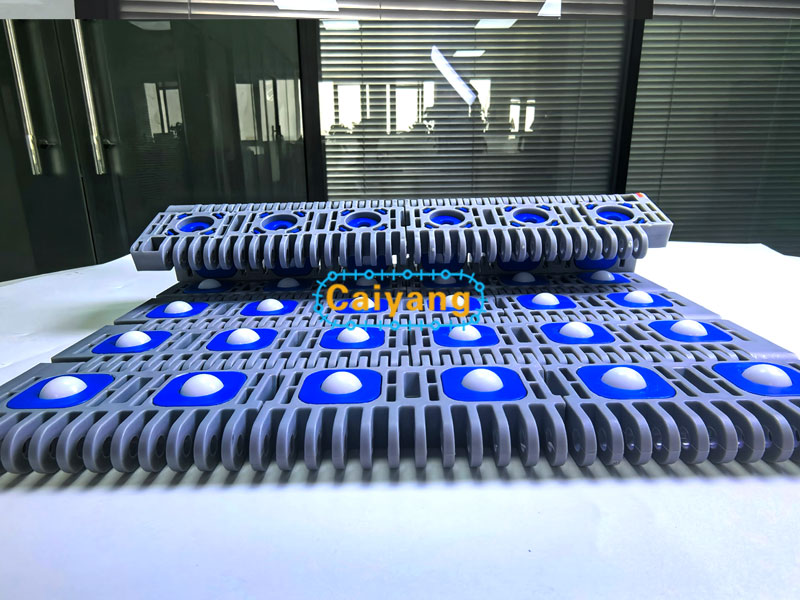
Modular plastic conveyor belts are primarily injection molded from engineering plastics, offering a variety of materials and specifications to suit different applications. Key materials include PP (polypropylene), PE (polyethylene), POM (polyoxymethylene/acetal), and nylon.
Through material modification, modular plastic conveyor belts can withstand a wide temperature range, typically -50°C to 120°C. Some belt types meet FDA and USDA hygiene standards and are suitable for the food and pharmaceutical industries. Key specifications of the product include the belt pitch and open area ratio. Common pitches include 10.2, 12.7, 19.05, 25.4, 38.1, 50.8, and 57.15 mm. Open area ratios can be selected from 2% to 48%, resulting in different surface structures such as flat, grid, open-hole, round-hole, and ribbed types to meet various process requirements such as drainage, ventilation, and anti-slip properties.
Modular plastic conveyor belts are injection molded from various engineering plastics such as PP (polypropylene), PE (polyethylene), POM (polyoxymethylene), and NYLON (nylon), and assembled through modular interlocking. Width and length can be customized as needed. The transmission method uses sprocket drive, preventing the conveyor belt from snaking or skewing. The belt body is thick and has properties such as cut resistance, impact resistance, oil resistance, and water resistance. Its structure is free of capillaries and gaps, meeting hygiene standards and easy to clean. Designed to prevent the penetration of contaminants such as blood and grease, and to prevent the adsorption of impurities, it also possesses a certain degree of chemical resistance. Its modular design facilitates maintenance. This conveyor belt has a wide operating temperature range, from -50°C to 100°C, and can perform various conveying methods including horizontal, inclined, turning, spiral, tilting, and vertical lifting. It is widely used in numerous industries such as food, beverage, pharmaceutical, chemical, electronics, automotive parts, and agricultural processing.
Modular plastic conveyor belts are widely used in packaging lines, seafood processing lines, frozen food production lines, battery manufacturing, beverage manufacturing, canning industry, agricultural processing, chemical industry, electronics industry, rubber and plastics production, cosmetics industry, and general conveying operations. Furthermore, its applications extend to the pharmaceutical industry (such as microwave drying, microwave sterilization, and pharmaceutical conveying), papermaking, printing, dyeing, tobacco, glass, steel, and stone industries. Modular plastic conveyor belts are also commonly used in the manufacture of specialized equipment such as bottle storage platforms, elevators, sterilizers, washing machines, and bottle coolers.
https://caiyangbelt.com/modular-plastic-conveyor-belt-2/
uni chain plastic modular conveyor belt
plastic chain price
plastic conveyor belt
plastic slat chain
conveyor belt food industry
conveyor modular belt
flat conveyor
modular conveyor
roller conveyor chain
chain conveyor solidworks
chain plate conveyor
conveyor belt 4 ply
conveyor belt malaysia supplier
modular conveyor
modular plastic chain conveyor
plate chain conveyor