
Modular plastic chain plate supplier
Why Plastic Slat Chain Is Better Than Rubber Conveyor Belt?
Rubber conveyor belts have been widely used for bulk material transport for decades. However, for automated food, beverage, packaging and daily chemical production lines, plastic slat chains have gradually become the preferred option, thanks to their sprocket-driven modular structure, stable flat surface and outstanding hygienic performance. This article compares their core differences and explains why plastic slat chains stand out in modern factory automation.
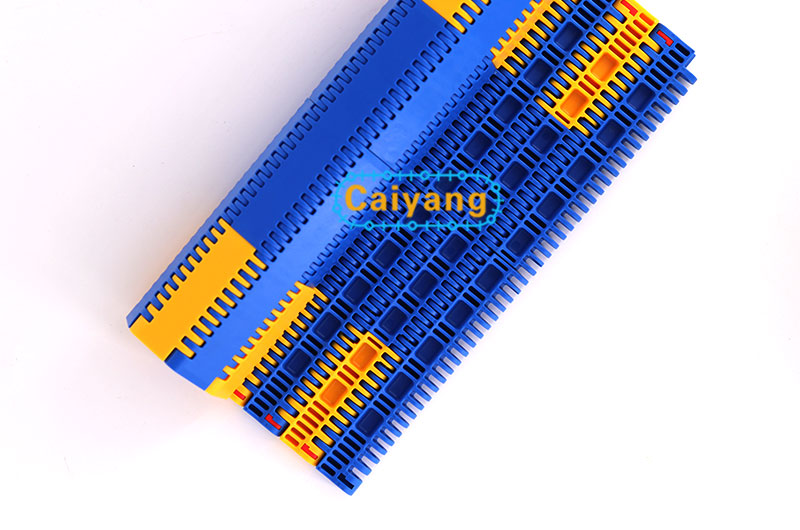
Positive Sprocket Drive, No Deviation or Slippage
Rubber belts rely on friction drive between pulleys and the belt surface. They are prone to deviation, slipping and tension loss when running at high speed, after cleaning or with uneven loads. Frequent tension adjustment is required to avoid shutdowns.
Plastic slat chains adopt positive sprocket engagement drive. The chain meshes precisely with matched sprockets. It will not slip or wander under stable speed, which is critical for labeling, inkjet coding and visual inspection stations. Bottles, cans and boxes stay in consistent positions without offset.
Modular Structure, Low Maintenance Cost
A damaged rubber belt usually means the whole belt must be replaced. Splicing rubber belts takes long downtime and professional tools.
Plastic slat chains are assembled by independent interlocking modules connected with pins. If one section is worn or broken, you only replace the defective single slat instead of the whole chain. Repairs are fast and can be finished without stopping the line for a long time. It greatly cuts maintenance expense and production loss.
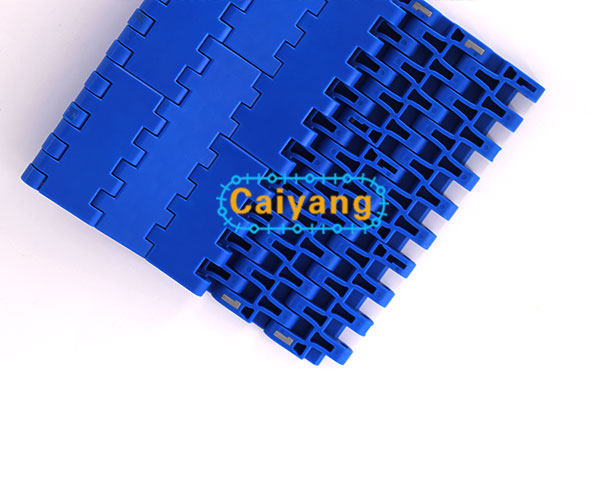
Superior Hygiene & CIP Cleaning Compatibility
Rubber has a porous surface. Food residue, sugar liquid, oil and detergent can easily soak into the rubber layer, causing mold, odor and bacterial growth. Some rubber materials will swell, crack or age quickly under repeated washing and sanitizer soaking.
Food-grade PP and POM plastic slat chains feature smooth, non-absorbent surfaces. They can directly withstand CIP spray cleaning and regular disinfection. No residue is trapped inside the material, fully meeting FDA and food safety standards for beverage, meat and fruit processing workshops.
Stable Flat Surface for Accumulation & Complex Layout
Rubber belts will sag under load and cannot support stable accumulation. They are hard to design for tight horizontal turns, merging and diverting.
Plastic slat chains maintain a rigid flat surface. They support product accumulation without sagging or tipping. The chain can run straight, turn horizontally, merge and split freely, matching compact factory layouts, buffer sections and case packing connections.
Better Chemical Resistance
Most rubber grades are sensitive to oil, alkaline cleaners, fruit acid and some sanitizers. Long contact will lead to hardening, cracking and surface peeling.
PP and modified POM slat chains resist weak alkali, water-based detergents and many food ingredients. They perform steadily in wet washing lines and chemical cleaning environments, extending service life.
Limitation Note (Objective Reminder)
Rubber belts still have their own advantages: they are suitable for long-distance bulk material conveying, high-impact heavy bulk goods and large inclined lifting. Plastic slat chains are not the best choice for these scenarios. For bottle, carton, packaged product automated lines, plastic slat chains are more competitive.
Typical Application Scenarios for Plastic Slat Chain
- Beverage filling and packaging lines: PET bottles, glass bottles, cans
- Food processing: packaged snacks, meat, seafood, fruit processing
- Daily chemical industry: shampoo, detergent, cosmetic bottle conveying
- End-of-line packaging: carton grouping, accumulation and case packing
Final Selection Tips
If your line focuses on packaged finished goods, bottle handling, frequent cleaning and stable positioning for automation equipment, plastic slat chain is a smarter upgrade over rubber conveyor belts.
More details, welcome to contact Shanghai Caiyang.