
Modular plastic chain plate supplier
Why Choose Ribbed Mesh Belt for Tire Production Conveying?
Introduction
Ribbed mesh belt is a specialized modular plastic conveyor belt developed for tire manufacturing workshops. Compared with ordinary flat mesh belts, its surface is designed with evenly distributed raised ribs. It is widely used for conveying green tires, vulcanized finished tires, rubber semi-finished products in tire factories. The rib-shaped structure solves common problems such as tire slipping, rolling, rubber sticking and poor air circulation during production. It has become a key conveyor component for rubber and tire production lines.
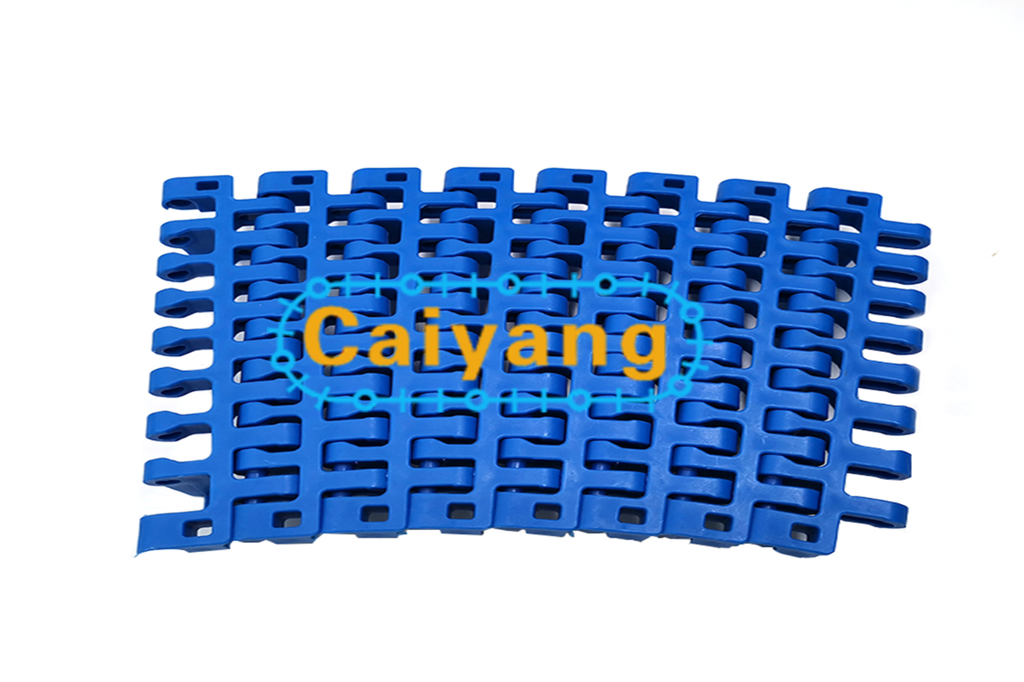
Core Structural Advantages
1.Anti‑slip rib design prevents tire rolling&slipping
The transverse raised ribs increase friction support between belt surface and rubber tires.When starting‑up,decelerating or running on slight incline sections,tires will not slide or roll sideways.Stable positioning reduces collision and surface scratch risks for semi‑finished and finished tires.
2.Groove gaps for heat dissipation and rubber chip removal
Grooves between ribs form natural air circulation channels.After vulcanization,hot tires can realize rapid air cooling.Rubber debris,rubber powder can fall through gaps,avoiding residual rubber sticking to the belt surface,lowering product contamination risk.
3.Modular assembly for easy installation&maintenance
Adopts interlocking modular plastic structure,assembled by hinge pins.If partial damage occurs during heavy‑duty tire conveying,only the failed single module needs replacement,no need to replace the whole belt.It shortens equipment downtime and reduces spare‑part cost.Width can be customized according to tire size and conveyor frame.
4.Optimized material formula for rubber‑industry working conditions
Main optional materials are high‑wear‑resistant POM and modified PP.The material resists rubber adhesion,grease and high‑temperature radiation from hot tires.It keeps stable mechanical performance under long‑term repeated heavy‑load impact of tires.
Typical Application Scenarios
-Transport of green tire before vulcanization
-Cooling conveying for vulcanized finished tires
-Sorting and distribution of finished tires in tire workshop
-Conveying rubber semi‑finished components
-Connecting each station of tire automated production line
Key Selection Points
Working temperature: Confirm actual surface temperature of tires.Select POM for high‑temperature residual‑heat working conditions;choose modified PP if there are oil‑spray or cleaning‑spray processes.
Load requirement: Confirm single tire weight and maximum load per meter,select reinforced ribbed mesh belt for heavy‑duty large‑size tires.
Spare‑part matching: Keep pitch consistent with driving sprockets to avoid deviation and abnormal wear.
Custom options: Side guards,baffles can be equipped to prevent tire deviation.
Conclusion
Ribbed mesh belt solves many practical pain‑points in tire manufacturing,including slipping,rolling,poor heat dissipation and rubber sticking.Its modular structure brings low‑cost maintenance.Proper material and model selection can greatly improve production‑line stability and reduce tire surface‑defect rate,which is an ideal conveying solution for tire and rubber‑product factories.