
Modular plastic chain plate supplier
Perforated Slat Chain vs Solid Slat Chain: How to Make the Right Choice
Plastic slat chains are the core conveying components of modern automated production lines, widely applied in food processing, beverage packaging, pharmaceutical, daily chemical and other industries. According to surface structure, they are mainly divided into perforated slat chain and solid slat chain. Both feature modular assembly, flexible layout ( straight, curved and inclined conveying ),food-grade safety and low maintenance costs, but they differ greatly in structural performance, applicable working conditions and functional advantages.
Many production engineers and purchasers often face confusion during selection: whether to choose perforated or solid slat chains for washing, cooling, drying, stable conveying and accumulating production lines. This article makes a comprehensive comparison from structure, advantages, limitations and application scenarios, helping you select the most suitable slat chain for your production line.
1.Basic Structural Difference
Solid Slat Chain
Solid slat chain adopts an integrated fully closed flat plate structure without any holes or gaps on the surface. The overall plate body is compact and uniform, with strong structural integrity. It is connected by standard hinge pins and driven by sprockets, realizing stable and continuous flat conveying. The fully enclosed surface avoids material leakage and deformation, providing ultra-stable support for all kinds of regular and irregular products.
Perforated Slat Chain
Perforated slat chain retains the rigid flat-plate base of solid slat chain, and is designed with uniform and orderly perforations on the plate surface. This unique structure combines the stable load-bearing performance of solid slats and the high permeability of mesh belts. The standardized hole layout ensures effective air circulation and liquid penetration while maintaining overall structural stability, achieving a perfect balance between support and ventilation & drainage.
2.Core Advantages & Limitations Comparison
Solid Slat Chain: Maximum Stability & Clean Conveying
Key Advantages
Ultra-stable load-bearing: The fully solid structure has high rigidity, strong compression resistance and anti-deformation ability, suitable for long-term conveying of heavy materials and high-load continuous production.
No material leakage: Zero gap on the surface, completely avoiding the leakage, jamming and falling of small materials, granular accessories and fragmented products.
Superior hygienic performance: The smooth and seamless surface leaves no dead corners for residue accumulation. It is easier to clean and adapt to CIP online cleaning and high-frequency disinfection working conditions.
Low noise & stable operation: The integrated plate body is matched with precise sprocket transmission, with no loose shaking during operation, ensuring high-precision stable conveying.
Main Limitations
The closed surface cannot realize air circulation and rapid water drainage. It is easy to accumulate water, heat and residual oil on the plate surface, so it is not suitable for production processes requiring cooling, drying, washing and draining.
Perforated Slat Chain: Drainage, Ventilation & Heat Dissipation
Key Advantages
Efficient drainage and ventilation: The uniform perforation design allows water, cleaning fluid and hot air to penetrate quickly, realizing rapid draining, surface drying and uniform heat dissipation of products.
Avoid residual moisture and mildew: It effectively solves the problem of water accumulation and heat retention on the surface of solid chains, preventing product deterioration caused by residual moisture.
Balanced performance: Compared with fully open mesh belts, it has stronger overall rigidity and will not deform or collapse when bearing materials, balancing ventilation and stable support.
3.Typical Application Scenarios
Choose Solid Slat Chain for These Scenarios
Solid slat chains are the preferred solution for dry conveying, stable accumulation, and high-precision transmission:
- Beverage and canned product filling, packaging and finished product conveying
- Daily chemical, cosmetic and pharmaceutical product assembly and sorting lines
- Heavy-duty product conveying and automated assembly lines
- Dry material processing lines that require strict prevention of material leakage
- production lines with high requirements for surface flatness and conveying stability
Choose Perforated Slat Chain for These Scenarios
Perforated slat chains are specially designed forwet processing, cooling and drying working conditions:
- Fruit, vegetable and aquatic product cleaning, rinsing and draining lines
- Bakery and snack post-baking cooling and air-drying conveying
- Meat product spraying, disinfection, washing and dewatering processes
- Fried food de-oiling and surface drying production lines
- Low-temperature pre-cooling and dehumidification conveying of quick-frozen food
4.Direct Selection Cheat Sheet
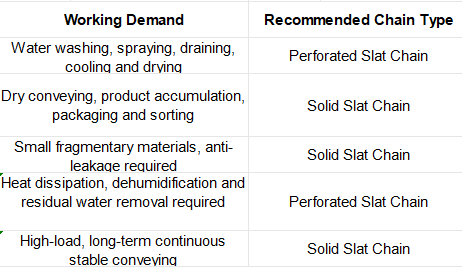
5.Material Compatibity & Service Life
Both perforated and solid slat chains supportfood-grade PP and POM materials, complying with FDA and EU food contact standards. PP materials features excellent acid and alkali resistance and hydrolysis resistance, suitable for long-term wet washing environmrnts. POM material has higher wear resistance and structural toughness, ideal for high-speed operation and heavy-load working conditions.
Under the same material and working conditions, solid slat chains have longer service life due to their integral structure, while perforated slat chains need regular cleaning of hole residues to maintain stable performance and extend service life.
Conclusion
There is no absolute superiority between perforated slat chain and solid slat chain, only the most suitable one for the working condition. Solid slat chains focus on stability, sealing and high load-bearing, which is the mainstream choice for dry packaging and assembly lines. Perforated slat chains focus on ventilation, drainage and heat dissipation, perfectly solving the pain points of water accumulation and poor cooling effect in wet processing production lines.
Reasonable selection according to production process requirements can effectively improve production efficiency, reduce cleaning and maintenance costs, and ensure long-term stable operation of the conveying line.