
Modular plastic chain plate supplier
Modular Plastic Belts: The Indispensable Conveyor Solution for Modern Food Industry
Modular plastic belts have quietly become one of the most critical transmission components in food production workshops. From raw material cleaning, lifting, sorting, cooling to packaging delivery, every link of food processing relies on stable conveying equipment. Compared with traditional metal mesh belts and rubber belts, food-grade modular plastic belts better match the sanitation, maintenance and production efficiency requirements of the food industry, and play an irreplaceable role in food automation production lines.
Strict Sanitation Requirements for Food Production
Food processing workshops face high standards of hygiene audit. Residues, juice and grease from fruits, vegetables, meat and prepared meals are easy to stick on conveyor surfaces.
Modular plastic belts are made of PP or POM food-grade raw materials. The surface is smooth and non-absorbent, and will not absorb food liquid,grease and odor. The modular splicing structure can be quickly disassembled on site without removing the whole belt, which is convenient for CIP online cleaning and manual deep washing. The belt material resists common acidic and alkaline cleaning disinfectants and will not rust like metal belts. It effectively reduces the risk of microbial growth and helps factories pass HACCP and food safety inspections.
Adapt to Diverse Working Conditions of Food Lines
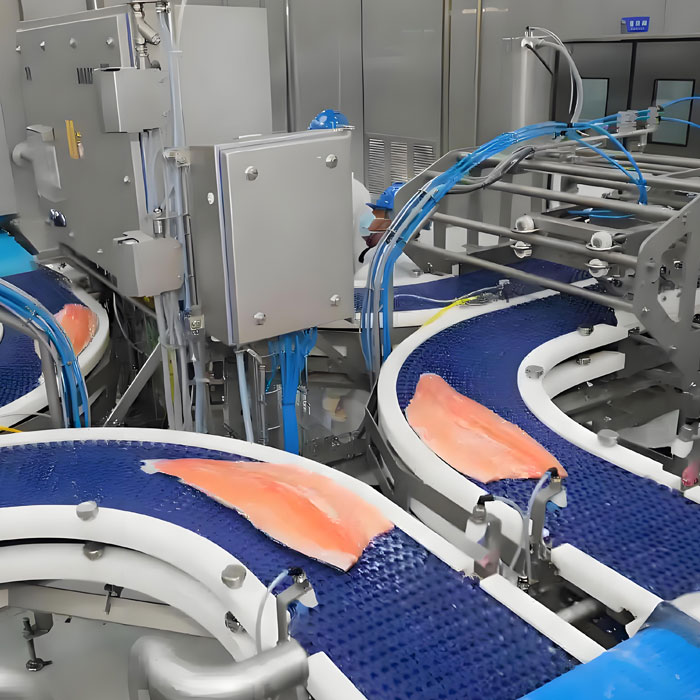
Food production covers many different processes, including soaking, draining, high-temperature blanching, low-temperature freezing, steep-angle lifting and curved turning conveying. Modular plastic belts can realize diversified customized structures according to different working conditions.
- For fruit and vegetable draining process: adopt high open-hole mesh belt to speed up water drainage.
- For inclined lifting feeding: add integrated baffles and side skirts to prevent materials from sliding back.
- For packaging tray conveying: use flat top slat chain to keep products stable without slipping.
- For turning production layout: select side-flexing modular belt to smoothly finish curve transfer.
Whether it is small granular materials, boxed finished food or bulk agricultural products, modular plastic belts can be customized in width, thickness, surface type and accessory structure to fit different production needs.
Reduce Production Downtime and Maintenance Cost
Traditional stainless steel conveyor belts are heavy, noisy and easy to wear. Once damaged, the whole belt needs to be replaced, which brings long shutdown time and high maintenance cost.
Modular plastic belt adopts single-module design. If individual piece is worn or cracked, users only replace the damaged module instead of the whole belt. This greatly cuts spare parts cost and shortens maintenance time. Plastic material is lightweight, which reduces the load on drive motor and frame, lowers power consumption and running noise, creating a quieter working environment in food workshops. The self-lubricating property of POM material avoids oil lubrication, eliminating the hidden danger of oil pollution to food products.
Protect Food Products from Damage
Many food materials are fragile: fruits, soft baked products, tofu and packaged goods are easy to scratch or break during transmission.
Hard metal belts are prone to scratch product surfaces. By contrast, modular plastic belts have moderate surface hardness. Custom anti-slip surface can prevent sliding during acceleration and deceleration. Baffles and side guards protect materials from falling, reducing product breakage rate and waste of raw materials.
Flexible for Old Production Line Renovation
Many food factories upgrade and reconstruct old production lines. Modular plastic belts have strong adaptability for renovation projects. It can match existing drive sprockets after parameter confirmation, and realize transformation without large-scale modification to the whole rack. It is an economical choice for factories to upgrade conveying system.
Summary
Automation is the trend of modern food manufacturing. As the core transmission medium, modular plastic belts support the continuous running of food production lines. It meets food safety standards, adapts to complex process layout,protects products, and controls long-term operation cost.
When building new production lines or upgrading old equipment, choosing suitable food-grade modular plastic belts is a key factor to guarantee stable and hygienic production.
Contact us to get customized modular plastic belt solution for your food processing line.