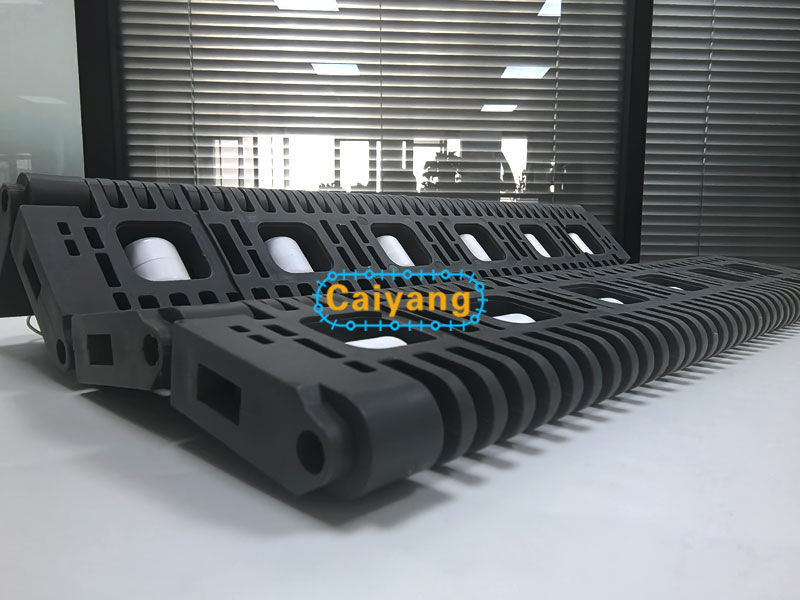
Modular plastic chain plate supplier
How to choose a plastic ball bearing conveyor belt
When selecting a plastic ball bearing conveyor chain, the key is to first clearly define the conveyed material, operating environment, and equipment structure, then check the specifications in the following order: material—ball bearing direction—pitch/model—width/length—manufacturer. You’ve been looking at chain plates, mesh belts, and sorting line products for the past few months; this time, the focus should be on whether the ball bearing structure meets your steering and sorting needs.
First, determine these 4 key parameters:
Material Selection: Choose according to the conveyed material and temperature environment.
POM (Polyoxymethylene): Wear-resistant, low-friction, high-strength, suitable for most industrial conveying and logistics sorting, temperature resistance approximately 4~80℃.
PP (Polypropylene): Resistant to acid and alkali corrosion, suitable for food, beverage, chemical, and humid environments, temperature resistance approximately 5~104℃.
PE (Polyethylene): Low-temperature resistant (down to -60~-80℃), suitable for freezing and quick-freezing lines.
Ball Bearing Direction: This is the core difference of a ball bearing conveyor chain, directly determining its conveying function. Directional Ball Bearings: Ball bearings are fixed in one direction, suitable for allowing items to slide out in a set direction or change direction.
Universal Ball Bearings: Ball bearings can rotate in multiple directions, suitable for logistics sorting and packaging lines, allowing items to change direction flexibly.
If the conveyor line requires turns, inclines, or a Z-shaped layout, choose a ball bearing mesh chain with turning capability or a matching turning chain plate.
Pitch and Model: Pitch is the distance between the centers of adjacent chain plates, directly determining the match with the sprocket.
Common pitches include 12.7mm, 15.2mm, 19.05mm, 25.4mm, 27.2mm, 38.1mm, 46mm, 50.8mm, and 57.15mm. Common ball bearing models include the 400 series (50.8mm pitch), 1005 series (25.4mm pitch), 900 series, and M5032 lateral/diagonal ball bearings, etc. Different models have different load-bearing capacities and applications.
It is essential to confirm the sprocket model of your existing equipment before selecting the corresponding pitch; otherwise, it will not be compatible.
Width and Length: Modular mesh chains can be made in almost any width, commonly ranging from 50mm to 3000mm in width, with lengths starting at 500mm to 1000mm. Customization is required based on the actual dimensions of the conveyor line.
Choose the right fit for your application scenario:
Logistics and Express Sorting Lines: Choose POM mesh chains with omnidirectional or lateral/diagonal ball bearings. These are wear-resistant, low-friction, and impact-resistant, such as the 400 series and M5032 series, suitable for high-speed sorting and package turning.
Food processing (meat, seafood, fruits and vegetables): Choose food-grade PP or POM mesh conveyors, which are acid and alkali resistant, easy to clean, and meet hygiene requirements. Common models include 5935 and 5997.
Quick-freezing/low-temperature lines: Choose PE material or low-temperature resistant models that can operate in alternating hot and cold environments.
Battery, electronics, and chemical industries: Choose corrosion-resistant PP mesh conveyors or models with baffles or side baffles.
What are the advantages of plastic ball bearing mesh chains?
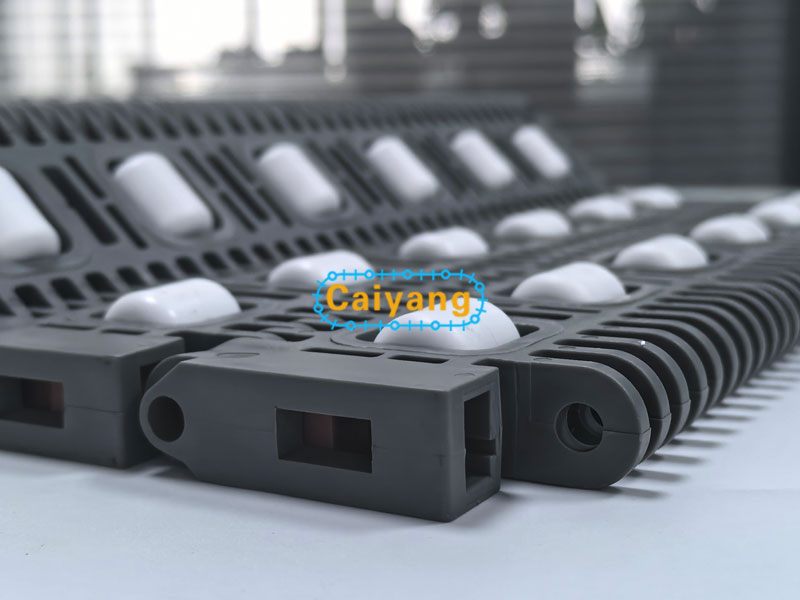
The core advantage of plastic ball bearing conveyor belts lies in their ability to transform sliding friction into rolling friction through embedded balls on the belt surface. This allows for flexible product steering, diversion, and low back pressure accumulation on the conveyor belt, while also leveraging the corrosion resistance, ease of cleaning, and lightweight properties of plastic conveyor belts.
Specific advantages can be summarized as follows:
Flexible Steering and Diversion: This is the most prominent function of ball bearing conveyor belts. The balls in the belt can rotate in all directions, enabling dynamic or static rotation of products during transport. This facilitates transfer, diversion, and product reversal within a small area. This is crucial for automated production lines that require adjustments to packaging direction or sorting.
Low Back Pressure and Product Protection: During product stacking and conveying, the ball bearing structure significantly reduces the pressure and friction between the product and the conveyor belt surface. It is particularly suitable for conveying shrink-wrapped or small-packaged products without flat bottoms, providing a stable conveying surface and preventing products from being scratched or damaged during congestion or accumulation.
Corrosion Resistance and High Adaptability: Plastic materials (such as POM, PP, and nylon) give the conveyor belt strong resistance to acids and alkalis, corrosion, and rust. Some modified plastic conveyor belts can withstand a wide temperature range (e.g., -40℃ to 105℃ or even higher) and can be used in food-grade direct contact applications.
Easy to Clean and Maintain: The smooth surface of the plastic conveyor belt does not easily absorb oil or impurities and can be directly washed with water. Its modular splicing structure means that if partial damage occurs, only the damaged link needs to be replaced, rather than the entire belt, reducing maintenance costs and time.
Lightweight and Low Noise: Compared to metal conveyor belts, plastic materials are lighter and operate with relatively lower noise. The ball bearings use low-friction materials, further reducing friction noise during conveyor operation, making it suitable for workshop environments with noise restrictions.
If you can tell me the specific type of product being conveyed (e.g., PET bottles, cartons, tires) and the operating environment (whether there are acid/alkali or temperature requirements), I can help you determine if this type of conveyor belt is suitable for your equipment.