
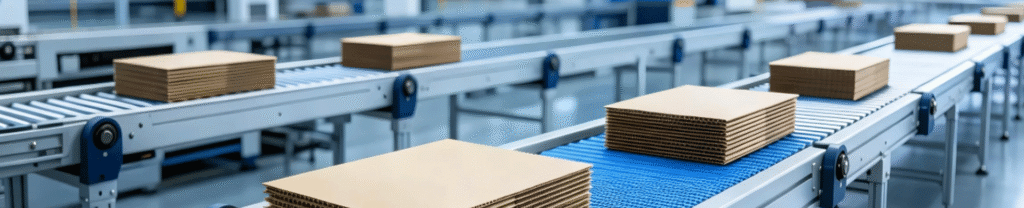
Modular belts, also known as plastic modular conveyor belts, are assembled by interlocking plastic modules and hinge pins. Unlike one-piece rubber belts, they are easy to repair, cut to width, replace locally and adapt to different production lines. There is no fixed, limited number of modular belt types, because manufacturers keep launching customized styles for special working conditions. However, they can be classified clearly by surface structure, running mode and material.
The most widely used modular belts by surface style include flat top, flush grid, perforated, raised rib, roller top, rubber coated top, and belts with flights or side guards.
- Flat top modular belts have solid, smooth closed surfaces. They offer stable support for packaged goods, boxes, bottles and finished food packs. They are popular in packaging lines where no water draining is needed.
- Flush grid modular belts are open-mesh designs with large open areas. This structure allows water draining, air circulation and quick cleaning. They are the top choice for seafood washing, vegetable processing, poultry handling, bakery cooling and freezing lines.
- Perforated modular belts sit between flat top and grid belts. They have small uniform holes on a solid base. They are used for mild drainage and ventilation when products cannot fall through large openings.
- Raised rib modular belts have raised strips on the surface. The ribs lift products slightly away from the belt plane to boost airflow and reduce sticking. Baking,cooling and drying processes often select this type.
- Roller top modular belts carry built-in small rollers. They help boxes slide smoothly when merging, diverting or sorting cartons in logistics and packaging workshops.
- Rubber top modular belts add a non-slip rubber layer on plastic modules. They prevent slippery products from sliding on inclined conveyors.
Modular belts can also be divided by running performance: straight-run belts and side-flexing (turning) belts. Straight-run belts are for linear conveying with high load capacity and low cost.Side-flexing belts are specially designed to go around horizontal curves, saving factory space with compact circular or U-shaped production layouts.
From the material perspective, mainstream modular belts are PP (polypropylene) , POM (acetal) and PE (polyethylene) . PP works well in wet food environments with good chemical resistance. POM has high hardness, low friction and great wear resistance, suitable for heavy-load, high-speed lines. PE performs better in low-temperature scenes. Special grades such as flame-retardant, anti-static and food-contact FDA-approved materials are available on request.
So the answer is simple: there are dozens of standard modular belt types, plus countless custom versions for unique requirements. The right belt depends on your product, environment, whether you need drainage, curve transfer, anti-slip or food-safe features.
More details, welcome to contact Shanghai Caiyang.