
Modular plastic chain plate supplier
Flexible Slat Chain for Complex Factory Layout
Many food, beverage and packaging factories face a common headache: limited floor space, scattered machines, and existing production equipment that cannot be rearranged freely. Traditional straight slat chains require a long, linear path and cannot adapt to bends, jumps or multi-level routes. Flexible side-flexing slat chains are designed to solve this pain point, allowing conveyors to follow customized routes to fit complicated factory layouts.
1.What Is Flexible Slat Chain?
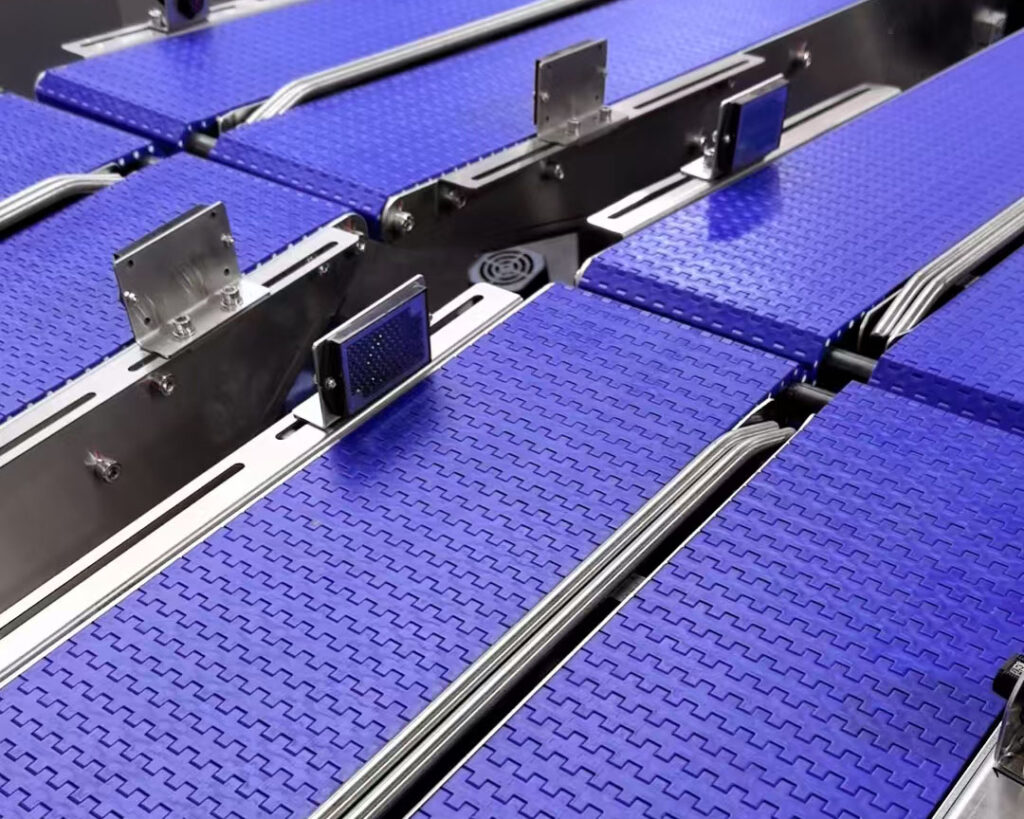
Flexible slat chain, also called side-flex slat top chain, is a modular plastic conveyor chain made of interlocking slat modules connected by hinge pins.
Unlike rigid straight-running slat chains, its special hinge structure permits horizontal bending. Most versions are made of POM or PP, with smooth top surfaces for stable bottle, can and packaged product transfer. It works with matched plastic sprockets and wear strips to realize smooth turning, S-shaped routing, U-shaped loops and multi-layer transfer lines.
2.Core Design That Adapts to Complex Layouts
- Side-flex hinge structure: The key design allows horizontal bending with a small minimum curve radius. It can turn 90°, 180°or form S-curves without extra transfer equipment. This saves valuable factory floor space.
- Modular assembly: Each slat is a separate unit. You can adjust total length, width and path freely according to the space between filling machines, labelers, case packers and inspection stations. Damaged modules can be replaced individually instead of changing the whole chain.
- Smooth surface & low product jam risk: Flat slat design keeps bottles, cartons and containers stable during turning. Zero-gap options prevent small products or package corners from being trapped at bending sections.
- Material options for different workshop environments: POM for high-speed dry packaging lines; PP for wet, CIP cleaning, corrosive food and beverage workshops.
3.How It Works In A Complicated Production Layout
In a typical old factory upgrade project, equipment is fixed and gaps are irregular. Flexible slat chain connects separate machines in these ways:
1.Go around pillars, support frames and other obstacles via curved sections.
2.Build U-shaped buffer loops for accumulation between upstream filling and downstream packing.
3.Realize multi-level transfer, moving products up and down to use vertical space.
4.Merge multiple incoming lanes into one single lane, or split one main line into several branch lines for sorting.
The whole line can be driven by fewer drive units,which greatly reduces the cost of multiple independent conveyors. It keeps continuous product flow without frequent handoff between different conveyors.
4.Main Advantages for Factory Layout Optimization
- Space saving: No need to reserve long straight channels. Perfect for old plant renovation where space is tight.
- Easy integration: Seamlessly connect fillers, labeling machines, case packers, checkweighers and palletizing stations. It fits high-speed beverage lines up to 13200 BPH like your customer’s project.
- Less transfer points: Fewer transfer stations mean fewer product tipping, jamming or scratching issues.
- Simple maintenance: Lightweight plastic structure, easy to disassemble and clean. Spare parts are low-cost.
- Adjustable later: If the factory changes layout or adds new machines, the chain path can be modified without rebuilding the whole conveyor frame.
5.Selection Notes & Limitations
- Confirm the minimum curve radius before ordering. Too tight a bend will cause excessive wear on hinges and side guides.
- Match dedicated curved sprockets and side wear strips. Standard straight sprockets will scratch the chain and lead to unstable running.
- Not suitable for ultra-heavy goods or sharp, abrasive products.
- For high-speed beverage lines, choose wear-resistant POM grade and calculate tension properly to avoid chain skipping.
- When connecting to existing conveyors, confirm the product transfer gap between the flexible chain and adjacent equipment.
6.Typical Application Scenarios
- Beverage bottling lines: PET bottles, glass bottles, cans routing through filling, labeling and packing
- Food & snack packaging lines
- Pharmaceutical and cosmetic carton conveying
- Old factory renovation, limited-space production upgrade
- Accumulation buffer loops and multi-lane merging/diverting stations
Summary
Flexible slat chains break the limitation of straight conveyor paths. For factories with irregular, crowded or old layouts, it offers a cost-effective way to connect scattered machines and build a continuous automated flow. Instead of moving expensive production equipment, you can design the conveyor route around your existing machines.