
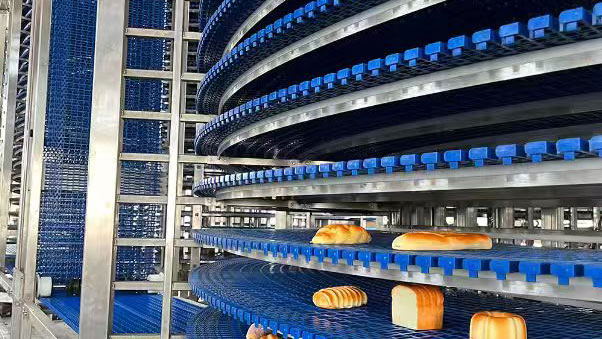
Classification of food mesh belt conveyors
Classification of Food Mesh Belt Conveyors
The classification of food mesh belt conveyors revolves around the hygiene standards, production process requirements, and material characteristics of the food industry. It is mainly divided into four core dimensions, with each category adapting to different food processing scenarios, balancing safety, practicality, and compliance. The detailed classification and explanation are as follows:
I. Classification by Mesh Belt Material (Core Classification, Adapting to Different Hygiene and Working Conditions)
The material directly determines the conveyor’s hygiene level, temperature resistance, and applicable materials, and is the primary basis for selection in the food industry. It is mainly divided into two mainstream categories: metal mesh belts and plastic mesh belts. Special materials are also available to adapt to extreme working conditions:
1. Metal Mesh Belt Conveyors
Using metal as the core material, these conveyors are high-strength, easy to clean, and corrosion-resistant, fully complying with food-grade hygiene standards. They are the most widely used type in food processing and are further subdivided into two categories:
– Stainless steel mesh belt conveyors: The mainstream materials are 304 and 316 stainless steel, with 310S stainless steel used in some high-temperature applications. They offer advantages such as high-temperature resistance (304 stainless steel can withstand 400℃, 310S can withstand 1200℃), corrosion resistance, and no unsanitary corners. They are easily cleaned with high-pressure water guns and steam sterilized, suitable for most food processing scenarios such as baking, frying, steaming, meat cutting, and fruit and vegetable drying. They can convey high-temperature, oily, or easily contaminated food materials, meet GMP hygiene standards, and are the preferred type in the food industry.
– Aluminum alloy mesh belt conveyors: Lightweight and corrosion-resistant, with a smooth surface that is easy to clean, suitable for light-load scenarios such as fruit and vegetable washing and low-temperature conveying. They are often used in small food processing plants, balancing economy and hygiene. They can be used in conjunction with stainless steel conveyors to optimize workshop layout flexibility.
2. Plastic Mesh Belt Conveyors
Made of food-grade engineering plastics, these conveyors are lightweight, low-noise, and scratch-resistant, suitable for light loads, low temperatures, or easily damaged food materials. Specific materials and suitable applications are as follows:
– PP (Polypropylene) Mesh Belt Conveyor: High cost-effectiveness, temperature range -10℃ to 120℃, smooth surface and odorless, suitable for fruit and vegetable sorting, beverage bottle conveying, and packaged food transfer. Customizable with different open area ratios (2%-48%) to balance air permeability and leak prevention, this is the most widely used type of plastic mesh belt.
– PE (Polyethylene) Mesh Belt Conveyor: Excellent low-temperature resistance, suitable for low-temperature applications such as refrigerated conveying in slaughterhouses and frozen food transfer. High toughness and impact resistance prevent material cracking at low temperatures. It is also water-resistant and easy to clean.
– POM (Polyoxymethylene) and NYLON (Nylon) mesh belt conveyors: Higher strength than PP and PE materials, wear-resistant, tensile-resistant, and with a high load-bearing capacity per meter (POM up to 13000 N/m). Suitable for conveying small-packaged foods and precision food parts (such as chocolate and candy), preventing material scratches, simple maintenance, and low replacement costs.
3. Special Material Mesh Belt Conveyors
Suitable for extreme working conditions and meeting special food processing needs:
– Teflon mesh belt conveyors: Made of fiberglass with a Teflon coating, resistant to temperatures up to 260℃, acid and alkali resistant, and non-stick. Suitable for sticky foods (such as chocolate and pastries), high-temperature drying, etc., preventing materials from sticking to the belt. Easy to clean, residue-free, and meets food hygiene standards.
II. Classification by Structural Form (Adapting to Different Workshop Layouts and Conveying Trajectories)
Based on the layout of food workshops and the needs of process connections, conveyors are classified into various structural forms to flexibly adapt to different conveying requirements, such as horizontal, inclined, and turning conveyors. The core categories are as follows:
– Horizontal Linear Mesh Belt Conveyor: The most basic and widely used type. The machine body is horizontal, used for connecting processes at the same height, such as conveying food after sorting and packaging. It has a simple structure, is easy to maintain, and can be customized according to the workshop length. The longest single-line length generally does not exceed 20 meters, suitable for the basic conveying needs of various food processing plants.
– Inclined/Lifting Mesh Belt Conveyor: The machine body is inclined, enabling materials to be conveyed from a lower height to a higher height. The inclination angle can be adjusted according to needs. It is usually equipped with anti-slip side guards and side plates to prevent material slippage. It is suitable for scenarios such as lifting fruits and vegetables after washing, transferring materials before drying, and lifting warehouse materials. The conveying capacity can reach 0.5~20T/h, and the power supports continuously variable transmission to adapt to different working conditions.
– Curved Mesh Belt Conveyor: Capable of 90° and 180° turns, its minimum turning radius adapts to narrow workshop layouts. It flexibly bypasses workshop obstacles, connecting production processes in different directions without requiring additional transfer equipment. Suitable for the complex layouts of small to medium-sized food workshops (such as pastry factories and beverage factories), its professional design ensures the mesh belt operates without deviation or jamming.
– Modular Mesh Belt Conveyor: Employing a modular splicing design, mesh belt units are assembled into an interlocking structure using plastic hinge pins. It can be freely spliced into any width and length. Baffles and side plates can be integrated with the mesh belt. Suitable for multi-row material conveying and irregular site layouts. Damaged parts can be replaced independently, reducing maintenance costs. Widely used for conveying beverage bottles, aluminum cans, and small packaged food materials.
III. Classification by Mesh Belt Style (Adapting to Different Material Shapes and Process Requirements)
Based on the weaving style or structure of the mesh belt, it adapts to food materials of different sizes and shapes, preventing leakage and jamming. Core styles are as follows:
– Herringbone Mesh Belt Conveyor: The mesh belt has a herringbone weave structure, providing stable conveying and strong load-bearing capacity. It is suitable for larger or heavier food materials (such as whole boxes of food, large fruits and vegetables), preventing material displacement during conveying. It also has a certain degree of air permeability, accommodating light drying needs.
– Diamond Mesh Belt Conveyor: The mesh is diamond-shaped, offering excellent permeability. It is suitable for scenarios requiring ventilation, heat dissipation, or drainage. For processes such as draining washed fruits and vegetables, drying food, and cooling, it effectively prevents the leakage of fine particles and is easy to clean, with no unsanitary corners.
– Type B mesh belt conveyor: The mesh belt is woven in a Type B pattern, with a smooth surface and small gaps, suitable for conveying small granular foods (such as candy, nuts, and flour), preventing material leakage. It is also easy to clean and suitable for refined food processing scenarios, seamlessly integrating with sorting and packaging equipment.
– Great Wall mesh belt conveyor: The mesh belt structure resembles the Great Wall’s battlements, boasting high strength and rigidity, capable of withstanding significant tensile and compressive forces. Suitable for conveying heavy-duty food materials (such as cases of beverages and large pieces of meat), it is wear-resistant and impact-resistant, ideal for bulk transfer scenarios in large food processing plants.
IV. Classification by Function and Application (Adapted to Specific Food Processing Techniques)
Focusing on specific food processing requirements, functions are designed to meet specific needs such as drying, cleaning, and sorting. The core categories are as follows:
– Cleaning Mesh Belt Conveyor: Utilizes corrosion-resistant, easy-to-clean stainless steel or plastic mesh belts. It can be equipped with sprayers, brushes, etc., to clean fruits, vegetables, and meats during transport. The permeable mesh facilitates wastewater drainage, making it suitable for fruit and vegetable processing and meat cleaning scenarios. It meets food hygiene standards and reduces manual cleaning costs.
– Drying Mesh Belt Conveyor: Equipped with a high-temperature drying device, the mesh belt is made of high-temperature resistant materials (stainless steel, Teflon). Its good permeability allows hot air to penetrate evenly, achieving food drying (such as fruit and vegetable drying and pastry drying). The conveying speed is adjustable to ensure uniform drying. Suitable for deep food processing scenarios, its drying efficiency is more than 30% higher than that of flat conveyor lines.
– Sorting Mesh Belt Conveyor: The mesh belt surface can be equipped with sorting baffles and diversion devices to achieve food grading and diversion (e.g., sorting fruits and vegetables by size, diverting foods of different specifications). It is suitable for food sorting and pre-packaging pre-processing steps, improving sorting efficiency and reducing manual intervention.
– Low Temperature/Refrigerated Mesh Belt Conveyor: Made of low-temperature resistant materials (PE, stainless steel), it can operate stably in low-temperature environments (below -10℃). It is suitable for conveying frozen foods and refrigerated fruits and vegetables, avoiding damage to the equipment from low temperatures while ensuring food freshness. It is widely used in slaughterhouses and frozen food processing plants.
Furthermore, according to load capacity, it can be divided into light-load, medium-load, and heavy-load categories. Light-load is suitable for small packages and small materials; medium-load is suitable for conventional food transfer; and heavy-load is suitable for full cases and large materials. According to the body material, it can be divided into carbon steel with painted finish and stainless steel body. Stainless steel bodies meet food hygiene standards and are the mainstream choice in the food industry, effectively preventing rust and food contamination, and are suitable for various food processing scenarios.
Different conveyors can be customized to meet different production needs.