
Modular plastic chain plate supplier
Battery Module Conveying with Ball Slat Chain
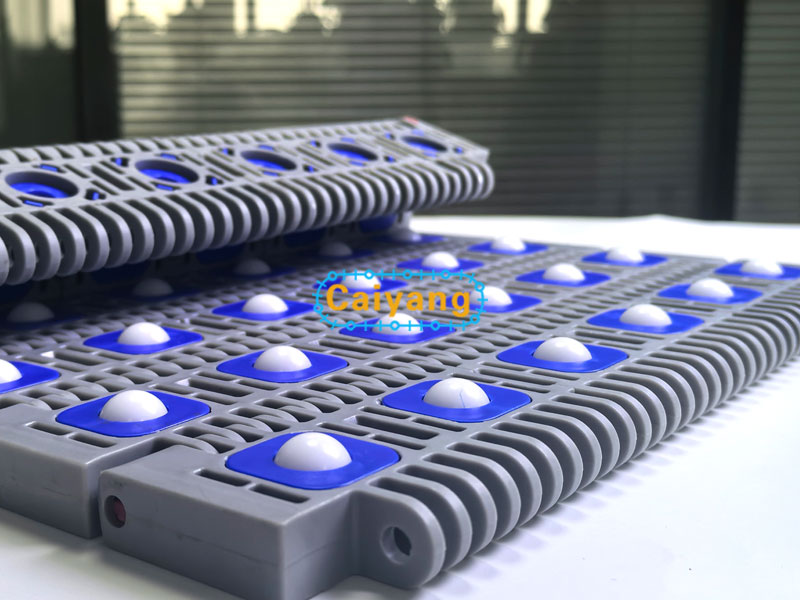
Lithium battery module production has extremely strict requirements for conveying stability, surface protection and flexible line layout. Ball slat chain, also known as ball transfer slat chain, is a preferred conveyor medium for EV battery module and energy storage PACK assembly lines. Its built-in ball structure brings unique low-friction performance, perfectly matching the accumulation, positioning, turning and docking processes of battery modules.
Working Principle
Different from ordinary flat-top slat chains, ball slat chain is embedded with free-rolling balls on the surface of each chain plate. When the chain runs forward, the balls can rotate independently. The battery module placed on top can slide horizontally with low resistance. This design realizes zero-pressure accumulation and flexible side shifting, which is very helpful for buffer conveying, stopping, positioning and diverting without scratching or applying excessive squeezing force to the battery module.
Material Selection for Battery Industry
- Modified POM: The mainstream option for most battery PACK workshops. It features high rigidity, low wear, stable dimensional accuracy, low dust generation and good anti-static performance. It is suitable for normal-temperature assembly sections, testing stations and turning transfer sections.
- Anti-static PP: Selected for scenarios with higher anti-static requirements. It can effectively dissipate static electricity and reduce ESD risks, widely used in cell stacking and pre-assembly areas.
- Conductive customized grade: For high-safety battery workshops, conductive ball slat chain can be customized to meet strict ESD protection standards and prevent static damage to battery cells.
Core Advantages for Battery Module Conveying
Zero-pressure accumulation without squeezing
Battery modules are precision products. Squeezing force may cause displacement of internal cells and hidden safety hazards. The rolling ball structure allows modules to stop and accumulate on the running chain without back pressure. It supports buffer storage before testing, sorting and packaging stations.
Gentle surface, no scratch damage
The smooth rolling surface avoids hard friction on the bottom shell of aluminum alloy battery modules. It will not leave scratches, abrasion marks or burrs on the module housing, helping manufacturers maintain high finished product appearance qualification rate.
Flexible layout with small turning radius
Ball slat chain supports horizontal turning, merging and diverting. It adapts to compact battery workshop layouts, saving factory space. It can connect multiple processes such as module assembly, insulation testing, OCV test, labeling and pallet transfer.
Low particle shedding, clean and easy maintenance
Modular splicing design. Single damaged chain plate or ball unit can be replaced separately, instead of replacing the whole chain. The structure has few dead corners, convenient for regular cleaning to reduce dust pollution in the battery production environment.
Stable running and low noise
Smooth rolling transmission reduces friction noise. It can operate continuously at adjustable speed, matching the beat of automatic manipulators, testing machines and robotic docking stations.
Typical Application Positions in Battery Lines
Ball slat chain is widely used in lithium battery production:
- Module assembly and buffer accumulation section
- OCV, IR electrical performance testing station infeed & outfeed
- Module labeling, coding and visual inspection conveying
- Turning, merging and diverting between multiple production lines
- Energy storage battery PACK pre-assembly and sorting lines
Key Selection Checklist
- Confirm ESD requirement: Ordinary anti-static or conductive grade, to match your workshop static control standard.
- Calculate module weight and single load, select suitable chain pitch and plate thickness.
- Confirm the minimum turning radius of the site; too small radius will cause ball jamming and abnormal wear.
- Match supporting sprockets, guide rails and wear strips of the same series to avoid deviation and jump chain.
- Clarify the ambient temperature of the workshop. Avoid long-term high-temperature baking which will accelerate plastic aging.
For lithium battery manufacturing, safe, stable and scratch-free conveying is the foundation of quality control. Ball slat chain provides a reliable low-pressure conveying solution for battery module logistics.
More details, welcome to contact Shanghai Caiyang.