
Modular plastic chain plate supplier
Application of plastic mesh belts in logistics and express sorting
Modular plastic mesh belt chain sorting conveyors are suitable for conveying various boxes, bags, pallets, and other goods. Bulk materials, small items, or irregularly shaped items need to be placed on pallets or in turnover boxes for transport. Modular plastic mesh belt chains can transport materials with large single-item weights or withstand large impact loads. They offer various structural forms; the roller conveyor lines can be divided into powered and unpowered roller conveyor lines according to the drive method, and into horizontal, inclined, and turning roller conveyor lines according to the layout. Custom designs can also be made to meet the diverse requirements of various customers. Roller conveyor lines are easy to connect and transition between each other; multiple roller conveyor lines, along with other conveying equipment or special machines, can be combined to form complex logistics conveying systems to fulfill various process needs. Kopei can use accumulating rollers to achieve material accumulation and conveying according to customer needs. The structure is simple, highly reliable, and easy to use and maintain. A fully automated express sorting line is disclosed, wherein the feeding conveyor belt is located at the front end of the equipment, the downhill conveyor belt is placed perpendicular to the feeding conveyor belt, the uphill conveyor belt is installed directly behind the downhill conveyor belt, and roller conveyor belt, horizontal conveyor belt, input conveyor belt, and packaging conveyor belt are sequentially placed directly behind the uphill conveyor belt; a rocker arm sorter and branch conveyor belts are respectively placed on both sides of the packaging conveyor belt, and a touch screen controller is placed on one side of the input conveyor belt; infrared sensors are respectively installed on the input conveyor belt, packaging conveyor belt, and branch conveyor belt; the feeding conveyor belt is installed at a higher position than the downhill conveyor belt. The beneficial effects of this utility model are: it realizes automated express sorting, greatly improves sorting speed, reduces a large amount of labor, saves labor costs for enterprises, and belongs to advanced technology in the express sorting industry.
Plastic conveyor belts are primarily used in the logistics and express delivery sorting industry for the automated transport and distribution of small parcels, soft-packed items, and cardboard boxes, covering the entire process from inbound scanning and sorting to outbound connection. Their ability to replace traditional belts and metal mesh belts stems from their lightweight, low noise, non-damaging properties, and ease of maintenance, perfectly matching the “high-frequency, light-load, and continuous operation” characteristics of express delivery sorting.
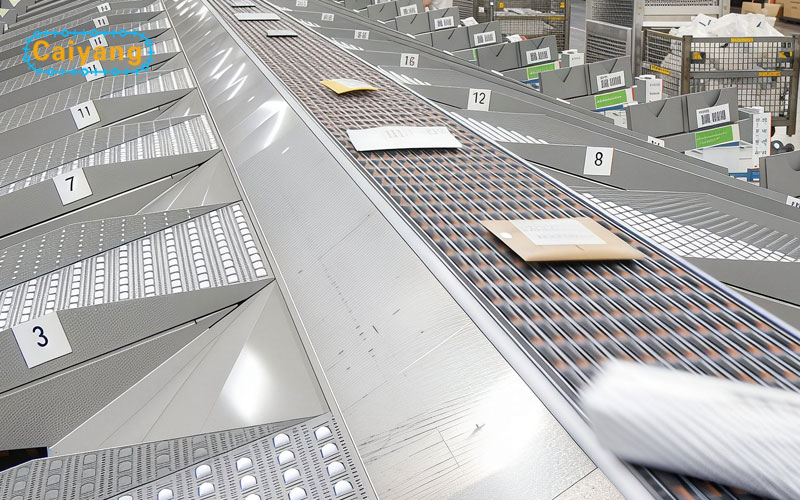
Main Application Scenarios:
- Automatic Sorting of Small Parcels in E-commerce Express Delivery: Express delivery distribution centers handle large daily volumes of diverse parcel types, including soft bags, small cartons, and clothing parcels. The smooth surface and moderate friction of the plastic conveyor belt prevent scratching waybills or packaging bags. Combined with scanning equipment and distribution mechanisms, it enables the automatic sorting and transfer of entire rows of parcels.
- Multi-level Warehouse Circulating Conveyor: Modern warehousing commonly uses multi-level automated conveyor lines for moving goods up and down floors and for cyclical turnover. Plastic mesh belts are lightweight and flexible, adaptable to small-radius turns and multi-layered folding layouts. They consume less energy and produce less noise than metal chain conveyors, making them suitable for high-frequency circulation within warehouses.
Incline Lifting and Material Drop Conveying: Sorting lines often have inclined workstations with bridges, inclines, and lifting/loading mechanisms. Customized anti-slip plastic mesh belts (e.g., with added baffles and side guards) prevent lightweight packages from slipping or falling laterally on inclined sections, reducing the risk of missed items or jamming. Engineering test data shows that specific modular plastic mesh belts can achieve a transmission efficiency of 94.2% at a 45° inclination angle and a 2.5kg load, with a low slippage rate.
Turns, Reversals, and Diversion/Merging: Express sorting often requires 90° and 180° turns for diversion. Ordinary belts are prone to wrinkling and deviation during turns, while modular plastic mesh belts offer precise engagement and smooth turning, ensuring package stability during turns and not affecting subsequent barcode scanning and identification.
** Air-drying and dust-removing auxiliary conveyor: In rainy, snowy, or humid environments, packages may accumulate water and dust. The perforated mesh structure of plastic mesh belts allows for ventilation and water drainage, enabling simultaneous dehumidification and dust removal with air-drying equipment during conveying.
Practical advantages compared to traditional conveyor belts: In express delivery sorting scenarios, the value of plastic mesh belts is mainly reflected in several specific aspects: They do not damage goods; the plastic material has no sharp edges, resulting in far less scratching of cartons, waybills, and flexible packaging compared to metal mesh belts; they can be partially replaced; the modular structure means that only a damaged section needs to be replaced, unlike a complete conveyor belt, significantly reducing downtime; they are lightweight and energy-saving; lighter than metal mesh belts, they have a lower motor load, making them suitable for 24-hour continuous operation; and they offer flexible routing, adapting to the compact layout of express delivery sites with many pillars and narrow aisles, allowing for small-radius turns and edge routing.
However, it is important to note that plastic mesh belts are not suitable for heavy-duty conditions. For scenarios involving large, heavy goods and cage cart turnover in express delivery sorting, roller conveyors or heavy-duty chain conveyors are still necessary. The location of the plastic mesh belt is clearly defined: a high-frequency, high-speed, flexible sorting section for light, medium and small packages.
Comparison of different plastic modular conveyor belts
| Modular mesh belt | Surface structure | Main advantages | Recommended industries |
| Flat-top modular conveyor belt | Closed plane | Smooth conveying and excellent product stability | Packaging, electronics, pharmaceuticals |
| Flat grid modular conveyor belt | Open mesh surface | Drainage, breathability and hygiene | Food processing, seafood, and vegetable cleaning |
| Modular conveyor belt on top of rollers | Built-in rollers | Product turnover, sorting and backlog | Logistics, warehousing, and parcel handling |
| Ribbed Modular Conveyor Belt | Surface of raised ribs | Enhance airflow to accelerate product cooling. | Bakery, fresh produce, refrigeration system |
| Perforated modular conveyor belt | Perforated surface | Drains quickly and is easy to clean. | Food processing, drying, and cleaning equipment |
| Modular mesh belt for turning | Modular structure of curved surfaces | Flexible conveyor layout and smooth corner conveying | Packaging, beverages, factory automation |