
Modular plastic chain plate supplier
Application and Material Selection Guide for Plastic Modular Belts and Flat Top Chains (Food, Logistics, Tire & Rubber Industry)
I. Industry Background: Indispensable Plastic Belts and Chains for Modern Conveying
The stable operation of automated production lines relies heavily on high-quality conveying components. Traditional metal mesh belts are prone to rusting, glue accumulation and corrosion, while rubber belts suffer from poor high-temperature resistance and slipping issues. These shortcomings make them inadequate for complex working conditions in food processing, tire and rubber manufacturing, logistics sorting and other industrial scenarios.
With outstanding advantages such as corrosion and oil resistance, high temperature resistance, easy cleaning and modular customizability, plastic modular belts and flat top chains have gradually replaced traditional conveying equipment. They effectively solve common industrial pain points including equipment corrosion, glue deposition and high maintenance costs, becoming core conveying carriers for modern automated production lines.
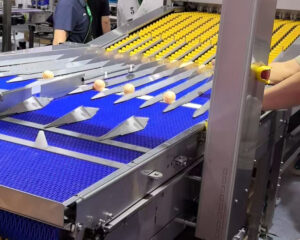
II. Features of Plastic Modular Belts & Applications in Food and Logistics Industries
Plastic modular belts adopt a modular hollow grid structure, injection-molded from engineering plastics and assembled with pin shafts. They feature good flexibility, reversible operation, flexible turning and convenient installation and disassembly. Their core strengths lie in excellent water permeability, air ventilation, no water accumulation and dead-angle-free cleaning, accompanied by superior wear resistance, corrosion resistance, oil resistance and light weight.
Wide Applications in the Food Industry: Food processing requires strict hygiene standards. Plastic modular belts have smooth, dirt-resistant surfaces that support high-pressure water washing and high-temperature disinfection. They are widely used in fruit and vegetable cleaning, food drying, quick-freezing cooling, baking transportation and aquatic product processing. The hollow grid structure enables rapid water drainage and heat dissipation, improving processing efficiency while complying with food-grade hygiene requirements and avoiding bacterial contamination.
Superior Performance in the Logistics Industry: Logistics sorting and warehousing feature high-frequency operation, large load capacity and complex working conditions. Lightweight yet high-strength plastic modular belts reduce conveyor load and energy consumption. With excellent tensile and wear resistance, they withstand long-term continuous cargo sorting and transportation without deformation or fracture, greatly lowering equipment replacement and downtime maintenance costs.
III. Characteristics, Material Selection and Industry Adaptation of Plastic Flat Top Chains for Tire & Rubber Industry
The tire and rubber manufacturing industry is characterized by harsh working conditions including heavy oil pollution, residual rubber adhesion, high temperatures and continuous heavy-load operation. Tailored for such scenarios, plastic flat top chains feature a solid and flat surface, high load-bearing capacity, outstanding oil and high-temperature resistance, and anti-adhesion performance. With non-porous and fully sealed surfaces that prevent the accumulation of rubber debris and oil stains, they operate stably without deviation or jamming.
These chains are suitable for full-process production such as rubber sheet conveying, tire tread forming, finished tire cooling and cutting sorting. The stable and smooth conveying surface avoids scratching or impacting rubber products, effectively protecting the appearance and quality of finished rubber and tire products.
The service life and working condition adaptability of flat top chains depend entirely on raw material properties. Three mainstream engineering plastics (PP, POM, PA) with distinct performances are selectively applied to different production processes of tire and rubber lines to achieve optimal matching:
1. PP (Polypropylene) — For Light-duty Auxiliary Rubber Working Conditions
PP features corrosion resistance, easy cleaning and cost-effectiveness, with a smooth surface that resists residue accumulation. It is only suitable for normal-temperature, non-high-temperature and light-load scenarios, such as normal-temperature sorting of finished rubber products and auxiliary transportation of light rubber materials in the tire and rubber industry. However, its poor high-temperature and wear resistance make it inapplicable for core production lines including tire forming, cutting and high-temperature cooling with high-temperature, oil-polluted and heavy-load conditions.
2. POM (Polyoxymethylene) — Preferred Material for Tire & Rubber Industry
As the most widely used material in tire and rubber production, POM boasts high hardness, superior wear resistance, excellent oil resistance, temperature resistance and aging resistance. It will not corrode or deform under long-term contact with rubber additives and lubricants. Its smooth surface resists rubber residue adhesion and is easy to clean. Adaptable to 24-hour continuous high-temperature and oil-polluted operation, POM flat top chains are widely applied in core processes such as rubber sheet conveying, tire tread forming and semi-finished product cooling, featuring stable operation, low noise and long service life.
3. PA (Nylon) — For Heavy-duty Rubber Working Conditions
PA nylon is characterized by excellent toughness, impact resistance and tensile load-bearing capacity, specially designed for heavy-load and high-frequency impact conveying scenarios in the tire and rubber industry. It is mainly used for transporting large rubber workpieces, heavy semi-finished tires and large-size rubber materials, resisting pressure and impact from frequent handling. Due to its disadvantages of water absorption, poor long-term acid-base corrosion resistance and high cost, it is only used for special heavy-duty scenarios rather than conventional conveying processes.
IV. Future Trends and Summary
With the intelligent upgrading of the food, tire & rubber, and logistics industries, conveying equipment is developing towards high precision, energy saving, environmental friendliness and durability. Featuring customizable design and low maintenance costs, modular plastic modular belts and flat top chains are gradually replacing traditional metal conveying accessories. The continuous promotion of modified materials with anti-static, anti-UV and high-wear properties further expands their application scope.
In conclusion, plastic modular belts are the optimal choice for food, water washing and cooling working conditions, while plastic flat top chains are more suitable for oil-polluted and heavy-load scenarios in tire and rubber production. For core tire and rubber production lines, POM materials are prioritized for their wear and oil resistance; PA nylon is selected for heavy-load and impact-resistant scenarios; and PP materials are ideal for cost-effective light-duty auxiliary transportation. Accurate product and material matching effectively improves production line efficiency, reduces long-term production and maintenance costs, and provides stable support for automated industrial production.